






















 Virgins hold a highly esteemed place in Spanish culture.
These Virgins can be found in their wooden and porcelain forms, resting in the alcoves of all local churches. These revered figurines are devotedly polished and dotingly prepared at different times of the year for participation in their own personal festivals. Adorned Virgin Mary statues can be found atop of Easter floats, which are solemnly paraded through the streets at Easter time. The Virgin of Carmen, or the ‘Virgen del Carmen’, as she is known in Spanish has her own special day in July.
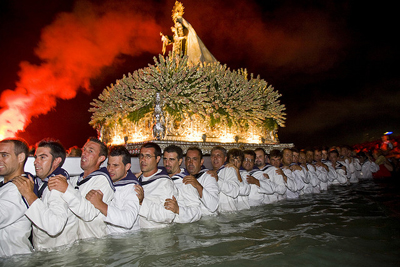
Each 16th of July, in Spanish seaside towns and villages, the ‘Virgen del Carmen’ is paraded upon a flower-adorned throne, through jam-packed streets filled with excited spectators, down to the local harbour. ‘La Reina de los Mares’ as she is also known, is the patron saint of the seas and protector of fishermen, seamen, swimmers and even scuba divers. This Virgin holds her esteemed place in Spanish religion and culture thanks to a respected prophet of the Old Testament, who apparently took refuge in a cave in a Mount Carmelo. When devotees of the prophet began to retrace his footsteps centuries later, the legend of the ‘Virgen del Carmen’ was borne.
Because she is the patroness and the protector of the seas, it is fitting that the ‘Virgen del Carmen’ be honoured in style at the beginning of each summer, so that the fishing may be bountiful and the sea clean and safe. The legend of the ‘Virgen del Carmen’ has been tailored to the times, as she is now seen in many places as the protector of scuba divers too.
The festival of the ‘Virgen del Carmen’ is bright, noisy and joyful, as you would imagine a typical Spanish fiesta of the summer to be. This celebration is an enchanting example of how Spanish religion and the culture of fiesta exist happily side-by-side. The proceedings begin with the ‘Virgen del Carmen’ being taken from the local church and placed in her position of honour on top of a flower-decorated throne. This is carried reverently and festively through the streets to the tune of a brass band and the cheering of crowds. And here one can experience the all-inclusive nature of Spanish hospitality, as anyone is welcome to join the crowd. The effigy is then taken to the local harbour, where the Virgin is reverently lowered onto a similarly flower-decked ‘jabega’, or fishing boat, so she can be taken out to bless the sea. Here throngs of fishermen and general party-goers join in with gusto. Throngs of boats follow the Virgin in her journey around the harbour. Prayers are said, horns are honked, thunderous crackers are let off, and music is played. There is an incredible mix of religious devotion blended with the never-ending partying associated with a Spanish summer. Many people jump in the sea and the revelry continues well into the night with fireworks, music, dancing and beach barbecues.
Often, Spanish flags accompany the colourful flowers and the Spanish National Anthem will be proudly played as the ‘Virgen del Carmen’ is also honoured as the patroness of the Spanish Naval Forces. In Malaga, scores of scuba divers visit the seabed to honour the statue of the ‘Virgen del Carmen’ that was placed underwater in 1981, when it was acknowledged by the Malagueños that the Virgin did indeed protect scuba divers too. In Puerto de la Cruz in Tenerife, white doves are released into the sky as the Virgin floats out to sea. In some places, celebrations are held before and even after this day. In Malaga, for example, the procession is repeated the Sunday after the 16 of July.
With the ‘Virgen del Carmen’ so suitably respected and honoured, the sea is ready to welcome the swimmers, the fishermen, the divers and the paddlers.
Where to go:
Marbella:
The effigy of the ‘Virgen del Carmen’ is paraded through the streets from 8 pm. Interestingly, this statue is kept absolutely safe and sound in a secure vault, 12 metres underground and only sees the light of day every 16th of July.
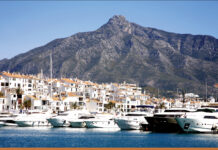
The effigy is placed on a boat at the Puerto Deportivo de Marbella and taken out to Puerto Banus. Thereafter she is returned to the Church of Nuestra Señora de la Encarnacion.
One week before the procession there is a mass held in honour of the Virgin, which includes a choir and a prize for the oldest retired fisherman in town. Celebrations are generally held over a seven-day period and include flamenco dancing, religious services and other special events.
Sabinillas and Duquesa:
Separate ceremonies take place in Sabinillas and Duquesa and boats sail up and down the Manilva coast. Best views are from the beaches of Manilva. The effigies are returned to their place of honour in the churches of Sabinillas and Castillo.
Benalmadena:
The procession leaves from Church Square, Avenida Bonanza after a mass at 7.30 pm and parades down to Benalmadena Port, where it is placed on a boat. A big fireworks display takes place on the Malapesquera Beach.
Estepona:
The procession starts at 8pm in the Parish of Our Lady of Carmen and follows the main road to Playa La Rada beach.
Sotogrande:
The procession starts in Torreguadiaro at 7.30 pm and makes its way down to the Puerto de Sotogrande where it is placed on a boat to cruise out back to the Torreguadiaro beach.
by Anita Pouroulis
Email: anita@pouroulis.com
Web: www.anitapouroulis.com
Tel: 697 624 552